How important is sound in film? Well, it’s more important than the image. Crazy talk, you say? Nope. It's much more important than your beloved images.
Think about it: how many times have you sat through a movie you watched back in the day on a fuzzy VHS tape? Many, I’m sure.
Now how many times have you got frustrated watching a DVD that had pristine, crisp images but bad audio? You can tolerate the bad pictures if the audio is fine but the other way around and you go mad, pull out your hair, strip naked and run screaming through the fields slaughtering animals on your way (?).
So how do you get clean audio?
Use good microphones and an audio recorder. Your audio equipment needn’t be something that is gonna leave you broke and homeless, but it should be up to the task.
Test your audio equipment before shooting. Go to where you wanna shoot and do some experiments where you talk and record it. If it sounds crap then you know its better to find somewhere else rather than cause yourself heartache trying to cope with crap sound in post-production.
Back to the topic of audio equipment: you don’t need some ridiculously priced brand name microphone with audio compressors and a fancy-schwansy recording device with 20 gazillion XLR inputs, etc.
A Dictaphone placed near the actors could do what you need it to.
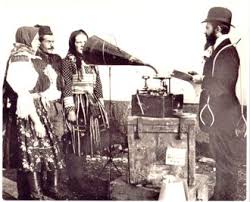
Do you need a sound person? It’d be nice to have one. But someone who is a sound person generally LOVES sound and might get on your nerves after a while as they ask for ‘another take’ because they heard a mouse tap-dancing just off screen.
If you don’t treat them nicely they could just walk off and then you are back where you started – except they’ve taken their fancy equipment with them AND the tapes with your audio!
Try your luck with a Dictaphone or cheap pocket recorder first and see how that goes.
The Sound of Silence.
Sometimes too much sound is bad.
From composing the soundtrack of every film I’ve made I know that it’s better to be selective in what you let the audience hear just as the cinematographer needs to be selective in what the audience sees.

On our short film A POLISH WINTER I was composing the music in bits and pieces that I kept adding to. Each piece sounded great on its own and in my head I thought ‘My God! This is going to sound amazing when it is all played at the same time!”
I was wrong.
Things may sound good on their own, but it needs to sound good in context otherwise it's just noisy crap. I went back over the music and made sure that the sound heard on screen was only what was needed and removed anything that got in the way - even if it meant scrapping stuff that I loved.
On the ALIENS DVD featurettes there is some good stuff on audio, and particularly the importance of silence. The sound mixer is talking particularly about the sequence in the film where the marines are investigating the miner's colony and they discover a person still alive but attached to the walls by the Alien gunk.
The sound levels drop dramatically (almost to silence) as they approach the seemingly dead person, but then the sound shoots right back up (with a flute-like high pitched squeal) as the head is raised and they are revealed to be very much alive.
The use of sound makes this scene have the 'leap out of your pants' scare effect!
And at the end when Sigourney Weaver says the line 'Get away from her, you bitch!", the sound drops again to emphasise the classic line and remove any background distractions.
So, audio is really important.
But the weird thing is the way that audio is treated in film-making. It is normally one of the last considerations when people are shooting.
I remember back in my college days of yore (circa 9000BC) and watching a student film that had ridiculously bad audio. When the characters mouths moved nothing came out, that’s how bad it was. Maybe it was audible to dogs? I don’t know. But it sure as hell was not audible to human beings.
The person that made the film told me that they shot the movie in a house that was right beside a busy road and the audio recorded was basically unusable. They had to lower the sound levels on the movie because otherwise the cars driving by on the soundtrack would be heard and ruin the mood (I think the film was supposed to be set in a rural, isolated place).
This happens all the time: film-maker finds great-looking location but doesn’t consider that it’s not great-sounding location. End result is frustration at your film being ruined by something so seemingly basic.
This is one of the main reasons why the vast majority of my films have featured no dialogue (or limited dialogue). Recording speech is tough. All it takes in a creaking door or a gust of wind blowing against the microphone to destroy what the actor is saying.
There’s a scene in BLUE VELVET where Laura Dern and Kyle McLaughlin are talking in a diner. I have no idea what they are saying for certain sections because the sound levels are awful.
This sort of audio problem happens all the time.
Mainstream movie's have ADR to compensate for this where the actors are brought back into little sound booths to re-record their dialogue in order to have perfect audio.
This seems very time consuming and wasteful; surely if the sound was recorded correctly the first time then everybody would be much happier?
Sometimes it’s unavoidable. You can’t help it if an aircraft flies over just as your lead actor is in the middle of making an important speech. And sometimes you just don’t have enough time to re-shoot because you need to get other shots or it’s getting late.
In those cases you may have to resort to ADR (which is a luxury for independent film-makers).
But what I don’t get is somebody deciding that they are going to shoot in a place next door to an airport landing strip and thinking that it won’t affect the audio!
So, recording your characters dialogue is the most important factor when making a movie. You could cheat by filming the entire movie with the speaking characters facing away from the camera and re-dubbing later on….but that is entering the Ed Wood school of movies!
On a side note, I've read before that one of the main reasons that people's films have not been accepted for film festivals is becasue of the quality of sound. It seems such a shame to spend time making something and then ignore the importance of sound...the thing that has the capacity to ruin all your work in one fell swoop if it is messed up.
-Shane
[All pictures from Google.com/images; images remain the copyright of respective owners]


